

As the nights draw in, we will soon start reaching for candles, fairy lights and anything that pushes back against the dark, so this month’s Members’ Spotlight feels particularly well timed. We’re shining a light – quite literally – on Paper Starlights, the Chesterfield-based fair trade paper lantern makers whose handcrafted stars have been bringing warmth, colour and a little bit of magic into homes for 30 years!
Paper Starlights is a partnership between two family businesses, one in India and one in the UK, built on decades of trust, friendship and a shared belief that trade can be a force for good. In a world that can feel increasingly divided, there’s something quietly powerful about a product whose entire philosophy is about bringing people together under the same sky. We asked the founders of Paper Starlights about craft, community, and why they believe fair trade is really “share trade”.
How a Diwali Night Sparked a Fair Trade Paper Lantern Business
We heard that Paper Starlights began after a captivating Diwali experience. What was it about those stars that made you think “we have to share this”?
Light, colour. Then the geometry, the simplicity, the structure – and the thought that somebody had made this simply to make people happy.
The stars were hanging along terraces and in doorways, lighting up everything around them. But we were just as transfixed by their effect on people and the spaces they occupied. They transformed an ordinary setting into an arena for celebration. In that moment, they seemed to be bringing people together.
We had no plan to start a business. We just thought, “Everybody should have one of these,” and that perhaps we were in the right place to help make that happen.


Every starlight is still hand screen-printed and hand-punched using traditional techniques. What does that process actually look like?
It’s very basic – in terms of the equipment. Each star is screen-printed by hand using a wooden frame, a canvas screen and non-toxic pigments. But the skill is anything but basic. That manual process creates a depth of colour and richness of tone that’s very difficult to reproduce by machine.
Colour is balanced by an expert eye. Years of experimentation with layering and overprinting have produced increasingly complex designs. The lanterns are then punched by hand with intricate pinholes, and tissue inserts are positioned by hand to create that stained-glass glow. Some designs involve more than 1,000 tiny pinholes; a sequinned design can involve 1,020 individual sequins. The size and position of every hole matters, because that’s what makes the star twinkle.
Three Decades of Trade Across Continents
You describe yourselves as two family businesses – one in India, one in the UK. How does that relationship work day-to-day, and what has it taught you about collaboration across cultures?
These days, every day begins with a “Good morning” message.
That relationship matters especially when trade becomes difficult. Working between India, the UK and the USA can place us in the middle of shifting tariffs, shipping costs and political tensions. Finding a route to consensus and effective action can be incredibly challenging. At those moments, all of us have to dig deeply into the values we share across the supply chain.
We’ve learned a great deal from the Bohra Muslim approach to business – about risk, honouring duty, choosing kindness, leaving room for experimentation and encouraging chance. (The origin of the word ‘Bohra’ actually means ‘to trade’). The now-retired founder of the business in India has been a mentor throughout our journey. He is wise, considered, switched-on, compassionate, kind – and all these things underpin his business.
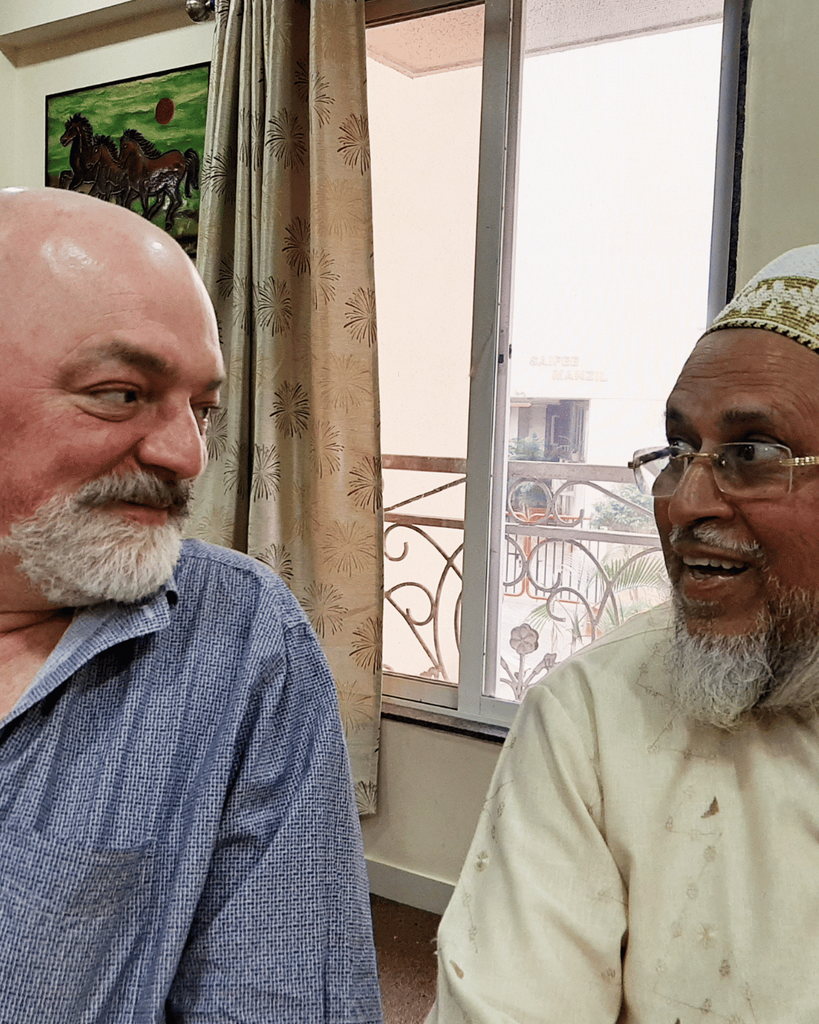


We’re now working with the second generation of the family business, with the usual means of instant communication at our fingertips. But when we began 30 years ago there was no email, internet or WhatsApp. Fax was new to both of us, and handwritten faxes had to be collected from local print shops. Phone calls were rare and connections clunky.
So how did we do it? I think it worked initially because we had a personal connection. We loved the product, and we shared intent, openness and mutual trust. This is something that transcends cultural difference, and still shapes how we do business now.
Meet the Makers: The Women Behind Your Fair Trade Home Decor
Many of your makers are women working flexibly around family life. What difference has fair, flexible work made to the artisan community you work with?
One of the most important things is that the work can be brought to where women live, rather than women having to travel to a remote workplace. Some making continues at home, giving people more control over how paid work fits around family life.
There isn’t one single model: some artisans are urban-based and others work in village settings. The circumstances differ, but dignity, flexibility and the ability to shape one’s own working life matter everywhere.
That flexibility can nurture pride, purpose, identity, personal autonomy and control over finances. It can also create a sociable, supportive community in which every role has equal status.
In 2026, Paper Starlights have begun working with a small number of women owned co-operatives and the Industree Foundation to develop stars and accessories made from bamboo. (Watch this space as the research comes to fruition over the next year or so!)
Heres Shanti (photo above), from one of these co-operatives in Karnataka :
‘I am Shanti. The products we make with our own hands are being sold in other countries. That makes me feel very proud. Before I joined this job I was dependent on family for everything. Now I can manage things on my own. Not only that, I can help my family. Earlier I knew very little about mobile phones. Now I know about mobile phones, banking and other related issues. I can go to an ATM on my own and withdraw money. Whenever my family faces personal or financial difficulties, I support them with my earnings and help them during difficult times. I am also supporting my younger sister’s education.‘
Beyond Fair Trade: Paper Starlights on ‘Share Trade‘ and joining the BAFTS Comunity
You talk about “share trade” rather than just fair trade. What does that distinction mean in practice?
We see our business as the sum of everything everybody brings to it. The human value of trade runs deep: box makers, truck drivers, clerks, administrators, shippers, sailors, event operators, online platforms and the Royal Mail driver on the last mile. There are so many people and skills involved, all with an input and all with an output.
The input is shared, so we like to think of the output as shared too. Fairness cannot begin and end with the relationship between a supplier and a buyer. It has to encompass everything in between – and far beyond.
For us, sharing also means alignment: sharing values, sharing plans and planning together. It means being honest about where each of us is, what we want to do and how we want to do it. We try to make sure we are all on the same page – and, if we are not, that we have at least read every page. It means transparency, and not being disingenuous.
What role has BAFTS and the Fair Trade community played in supporting Paper Starlights, and why does that network matter to a business like yours?
We are quite new to BAFTS and, if truth be told, we arrived with a little scepticism. Fair trade frameworks can sometimes feel post-colonial or one-size-fits-all. We also come from the festival and market community: a gloriously idiosyncratic group of itinerant traders making their own way, often with a broad set of ethics but not much enthusiasm for being squeezed into a box.
What changed for us was recognising how essential it is for an alternative business culture to emerge. A culture organised only around growth, profit and personal benefit can be deeply dehumanising. We need places where people can build consensus around different motivations – fairness, justice, shared value and the collective good.
We’re still at the beginning of our BAFTS journey, but we’re grateful for the work being done to articulate an ethos we feel comfortable inhabiting. BAFTS feels like a platform for debate rather than a fixed definition. It has an open ear and recognises that other cultures have a great deal to teach us about trade as a fair, values-led exchange.
It also matters that the people who “run” BAFTS are traders themselves. They are directly involved in the world they are exploring. What excites us most is what the next generation will bring: new ideas, less twentieth-century baggage and a real passion for what is fair and just.
The Next 30 Years: What’s Next for Paper Starlights
Nearly 30 years in, what does the next chapter look like for Paper Starlights?
What excites us most is not the what, but the how. And, to an extent, the where.
Indian producers are increasingly focused on a strong domestic market, while exporters face shifting tastes, tariffs and uncertainty. We have more to learn from our partners than ever.
Our business was built on the generosity of Indian business owners. They have been our mentors, spiritually and professionally – the heroes and visionaries of this story. They have taught us about balancing work and family, eating well, enjoying life and giving.
This year, we spent several days with our producer partners asking how we can sustain the relationship for another 30 years, and what we need to put in place now.
As well as trading, we’re also creating installations in visitor attractions, heritage spaces and places of faith. Our first experience of the stars had been that they brought people together. 30 years on we’re celebrating and exploring this further through the installations which are themed around being ‘under the same sky of stars’ – spaces where different traditions meet and beautiful décor becomes a multi-faith dialogue.
We’re also working with two young UK market traders building what they call “ethical businesses”. Their energy will drive the next ideas of fair trade. We can offer guidance and share what we have learned, but the future belongs to them.

As the Nights Draw In: Ethical Christmas Lights for a Darker Season
We are now moving into darker autumn evenings, do you see changes in the business along with the seasons?
Our desire is to live in light, and we finance this by selling shedloads of stars at Christmas.
Demand rises through autumn and peaks in the run-up to Christmas. That follows the stars’ own cultural life in India, where they are used by different faiths for both Diwali and Christmas. Despite the very different climates, there is a lovely rhythm between the Indian and UK markets – although here we are perhaps more likely to be getting cosy indoors.
Colour changes with the seasons too. Spring and summer invite pastel and floral shades. Autumn brings richer oranges, deeper tones and Halloween colours; orange also has a strong place at Diwali. At Christmas, people often turn to whites and neutrals. And throughout the year, anything goes for a wedding, party or celebration.
As the nights lengthen and winter approaches, we meet the darkness with celebrations of light. We carve pumpkins, parade lanterns and let off fireworks. We greet the gloaming with a show of light, a burst of festivity – and a bright, shining star.
Wherever we are in the world, it seems a little light goes a long way.